

August 14, 2026
Expert Voices: Health Is Not Separate From Learning—It’s a Prerequisite
Karen Graf on the evolution of school nursing, the future of student health, and the power of advocacy.
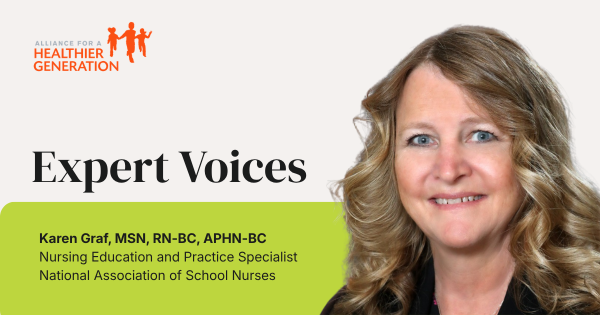
Health and education have always been deeply connected. From the earliest days of school nursing to today’s increasingly complex student health landscape, school nurses have played a critical role in ensuring students are healthy, safe, and ready to learn.
At Healthier Generation, we believe every student deserves the opportunity to thrive. Through our Expert Voices Series, we’re highlighting the leaders, ideas, and innovations shaping healthier learning environments.
In this conversation, Karen Graf, Nursing Education and Practice Specialist at the National Association of School Nurses, reflects on the evolution of school nursing, the changing needs of students, and the opportunities ahead for the profession. With deep roots in nursing—her grandmother entered the profession in 1907—Karen brings both historical perspective and forward-looking insight into the future of school health.
Q: How has the role of school nurse evolved over time?
Karen Graf: I want to start way back in 1902, when Lillian Wald launched a month-long experiment in New York City that changed the face of American education. To combat skyrocketing absenteeism caused by communicable diseases, Wald pioneered a model focused on one mission: to stop the spread of illness so children are well enough to learn.
Lina Rogers, the first official school nurse, proved this model’s effectiveness immediately. By treating children on-site, she reduced absenteeism by 90% within a single year, sparking the rapid adoption of school nursing programs across the country.
Early pioneers recognized two fundamental truths: first, that health is the foundation and a child battling illness cannot fully participate in education if they are not well. Second, that a child’s life outside of school directly impacts their success within it. Those ideas planted the seeds of the whole child philosophy.
Today, school nurses are connectors, collaborating on nutrition, mental health, housing insecurity, and food access. We understand that a student’s sense of belonging and home environment are just as critical as their physical health.
“The whole child is no longer just a concept. It’s a coordinated system of care.”
Q: What questions will shape the future of school nursing?
Karen Graf: As we look to the next 100 years, our profession is shifting from reacting to the needs of children to predicting them.
This raises important questions about ethics, privacy, and the boundary between support and intrusion. What does it mean to care for a student when we understand their health at the level of their DNA? How does the school nurse’s role transform when AI can predict a crisis before it happens?
We also need to ask how we build systems that honor neurodiversity and biology without reducing students to data points. At what point does supporting the whole child become shaping the child? And who decides what “optimal” really means? These are the questions that will help define the future of nursing.
“Supporting the whole child by ensuring every student is healthy, safe, and ready to learn remains the heart of our work.”
Q: What gives you hope about the future of school nursing?
Karen Graf: Working with nursing students and seeing the next generation of nurses treat schools as a primary site for public health shows that our profession is evolving.
There is also a new energy around using data to prove our impact, finally giving school nursing the visibility it deserves.
Q: What systemic changes would better support school nurses?
Karen Graf: One of the biggest changes is staffing reform. We need to move away from mandated ratios and toward acuity-based models that reflect student complexity rather than simple enrollment numbers.
Administrative support is also critical. Non-clinical staff can assist with tasks like data entry and attendance tracking, allowing nurses to focus on patient care.
At the national level, we need sustainable funding, policy change, and Medicaid optimization. We also need to encourage and empower school nurses to find their voice, lead, and advocate for change at the local, state, and national levels.
Q: What action is most needed to move the profession forward?
Karen Graf: We need more strategic advocacy for inclusive student health.
Communication is vital. Nurses must actively share their clinical judgment and their impact on patient care. That means speaking without jargon, telling nursing stories while protecting confidentiality, and engaging with the media and legislators.
Ultimately, our clinical expertise must be matched by a strong public voice. If we don’t shape the future of our profession, others who often lack clinical insight will determine the direction of student healthcare.
“Our clinical expertise must be matched by a strong public voice.”
Q: What role does mentorship play in strengthening the workforce?
Karen Graf: Building professional connections has been essential to my own growth. For nurses who feel isolated, mentorship can be found in many places: through state school nurse associations, conferences, NASN’s SchoolNurseNet community, and specialty interest groups. Sometimes a mentor begins with a conversation at a conference or through an online discussion.
Q: Why are professional learning communities so important?
Karen Graf: Shared spaces transform the experience of school nursing from one of isolation to one of collective empowerment. Whether it’s a conference, webinar, online community, or learning session, these spaces validate the experiences of school nurses, create opportunities for storytelling and advocacy, and reinforce a sense of belonging to a profession that has supported children for generations.
Continue the Conversation
Watch the full webinar, Trusted, Valued, Essential: A Celebration of School Nurses, to hear more from Karen Graf and explore the role of school nursing in supporting student success.
Learn more about Healthier Generation’s work to support School Health Services.